|
Then and Now
Westbus has provided
bus services to the communities of Western Sydney for
more than forty-five years. Established in 1955 by the
Bosnjak family, various small bus companies were purchased
as residential development occurred, and merged to form
the one company.
The company began
with 5 buses and the rights to operate a service from
Canley Vale station to Edensor Park in 1955.
|
Trading as Bosnjak's Bus Service, the company purchased
Parramatta Bus Company in Parramatta, WJ Bales Bus
Company in Penrith and opened a new depot in Boundary
Road, Northmead. With the purchase of Bowman's Bus
Service in St Mary's in 1983, the entire operation
was renamed Westbus. This not only reflected the
geographical location of the company's operations
but the pride in being the Western Sydney Bus Service. |
|
International
Expansion
Commencing operations
in the United Kingdom in 1986 was a giant step for Westbus.
Two depots were purchased, in Ashford and Hounslow,
with an existing fleet of buses and coaches. The coaches
were used for international tours and charters with
travel throughout Great Britain and Europe. The bus
operations were later sold off and the coach operations
were consolidated into Westbus International Luxury
Coach Travel operating from a depot close to London's
Heathrow Airport. Many a traveller from Sydney has expressed
a feeling of comfort on seeing the familiar Westbus
livery on the coaches.
|
New
Technology
In the mid 80's,
Westbus was one of the first operators to use
electronic ticket machines.
These
not only issued tickets but also provided computer
data on tickets sold and passengers carried. This
data was transferred from the ticket machines
on the bus to the computer located in the depot
by means of a smart card carried by the driver.
|
|
Further Growth
Westbus acquired the
Route 715 service from Toongabbie Transport in 1987.
This was a route-only purchase in that no buses or equipment
were exchanged. This was a further enhancement to the
Hills District services with this route operating from
Seven Hills to North Baulkham Hills. Later that same
year Macquarie Towns Coachlines, located at South Windsor,
was purchased.
The following year, 1988 saw the purchase of Toongabbie
Transport Company and its depot at Seven Hills to complement
the Route 715 service purchased the previous year. The
Calabro's bus service located at Bonnyrigg was the next
company to be bought by Westbus.
With the purchasing of these various companies over
the years there were a variety of bus types in the fleet.
In 1982 the company embarked on a fleet upgrading programme
to rationalize the bus types and to improve upon the
service reliability.
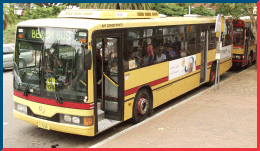
The upgrading of the fleet concentrated on bringing
high quality Volvo and Mercedes Benz chassis into the
company. A local Smithfield firm, Custom Coaches, constructed
the bodywork of the vehicles. With over 200 buses built
between 1982 and 1992 this provided many employment
opportunities in western Sydney.
The
early eighties also saw Westbus introduce the first
cross regional bus services in western Sydney, in co-operation
with the State Government. Today, Westbus operates a
number of cross-regional services providing important
links to shopping centres, employment areas, tertiary
education centres and residential areas. The services
include Route 830 from Liverpool to Castle Hill, route
835 from Liverpool to Penrith, Route 630 from Macquarie
Centre to Blacktown, Route 678 from Penrith to Richmond,
Route 673 from Penrith to Windsor, Route 608 from Windsor
to Castle Hill, Route 800 from Liverpool to Parramatta
and Route 715 Blacktown to Castle Hill.
 |
The
last local company purchase came with the acquisition
of the Richmond Bus and Coach Service in 1994.
This operation was then combined with the South
Windsor depot.
Today Westbus operates bus depots at Bonnyrigg,
Northmead, Penrith, Seven Hills and South Windsor.
|
In
May 1999, National Express Group, UK became the major
shareholder of Westbus. National Express is based in
the UK and operates transport systems in the U.K, U.S.A
and Australia, including buses, coaches, trains, trams
and airports.
The Nepean Nipper
On 13 February
1993, Westbus introduced the "Nepean Nipper"
high frequency minibus network to the Penrith District.
Some of the features of this service included:
Double the frequency
on all bus routes within the Penrith urban area. Introduction
of new Mercedes-Benz minibuses, being customer orientated
with lower step heights.
Hail-n-Ride services:
Drivers of Westbus' new minibuses began stopping where
passengers hailed them along the route, apart from the
set stops within the Penrith Shopping area.
| The
separation of school bus travel from normal services
buses. The initial order for 26 Mercedes Benz minibuses
were built locally by Custom Coaches, at Guilford
in Western Sydney. More than 18,000 man-hours were
used to build these buses, which created another
10 full-time manufacturing, jobs in Sydney's West.
|
|
The new minibuses
allowed environmental improvement and made a substantial
inroad into car utilization in Australia's urban environment,
with the consequent reduction in pollution.
The investment made
by the company for the Nepean Nipper services totaled
three million dollars in capital investment for buses,
research and planning costs in producing new routes
and schedules, wage costs for the additional bus drivers
employed and funding that was required to cover the
time lag between service introduction and the relevant
growth in patronage and revenue. The introduction also
enabled 18 new jobs to be created in the Western Suburbs.
Hills City Express
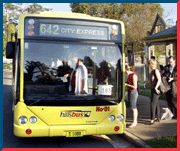
Westbus commenced
operation of its Hills-City Express services in mid
1996. These services were instigated following the opening
of the new Glebe Island Bridge and the introduction
of Transit Lanes along Victoria Road from Ryde to the
Sydney CBD. Residents of the Hills district had indicated
a desire for a direct service to the City. However,
prior to the completion of the Glebe Island Bridge it
would not have been possible to operate services to
a reasonable travel time.
The
service started with three routes from Castle Hill to
the City, Castle Hill to North Sydney and Winston Hills
to the City. These services experienced growth over
the next twelve months however, with the opening of
the M2 Motorway and the subsequent reduction in trip
times the patronage skyrocketed.
 |
The M2 Motorway
was constructed to incorporate exclusive bus lanes
and bus stations at a number of locations. Westbus
was successful in negotiating with the Department
of Transport to operate services along the Motorway.
This provided the unique opportunity for Westbus
to operate express services to the City and North
Sydney faster than is possible by car.
This had already
been proven by the Member for the Hills, Michael
Richardson MP when he carried out a comparison
between the Castle Hill to the City service along
Victoria Road and a private car.
|
This
travel time was further improved upon the opening of
the M2 as travel times were reduced by up to 35% with
the use of the bus lanes on the M2 and the Sydney Harbour
Bridge. The opening of the M2 and the subsequent increase
in patronage on the service meant that the service was
expanded to provide additional routes, more buses during
the peak periods, services seven days a week and buses
operating from the City up to 11.00 p.m. Monday to Thursday
and 2 am on Friday and Saturday. The additional routes
have included a peak hour service from the Bella Vista
Estate at West Baulkham Hills to the City with pick-ups
on the M2 at Winston Hills and Baulkham Hills. A service
was introduced from Blacktown and Seven Hills to Macquarie
University and Macquarie Shopping Centre and also from
Rouse Hill to the City.
The aim of Westbus was always to provide a fully air
conditioned service from Castle Hill to the City and
this was achieved at the beginning of December 1998.
The 30 buses provide an investment by the company of
over $8 million dollars in equipment and drivers on
the Express services.
Consolidation
2001 - 2002
2001 was a year of
consolidation and upgrading for Westbus. After the purchase
by National Express UK, more than $40 million was invested
in both the fleet and the refurbishment of depots.
Seventy-one new buses as well as the complete rebuilding
of the Bonnyrigg depot took place during this time.
Many of the buses were either low-floor accessible buses,
air-conditioned, or both.
In order to cope with the increased customer demand
on the M2-City routes, five new articulated (bendy buses)
buses were purchased. These vehicles were the first
new articulated buses to take to Sydney roads in more
than twenty years.
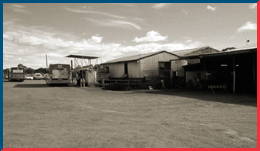
Bonnyrigg Depot - Before
 |
Bonnyrigg Depot - After
 |
Planning
is also underway to assess what services are to be put
in place in the expanding population areas in our catchment
region. We understand that bus services need to be in
place in the new areas as soon as the residents start
to move in. Of course, this is always dependent on the
road network being in place to allow the buses to operate
efficiently.
Click
Here to see Our
Future
|


